On this page
Palletizing is a stability problem before it is a gripping problem — the product has to stay where it was put, through acceleration, through the release, and through every layer built on top of it. Most palletizing specifications that fail begin with a payload number and never ask how much of the load the fingers actually transfer, or what the product does when the robot is moving fastest. Both of those decide the outcome more often than the payload figure does.
The second thing worth saying early is that a large share of palletizing work is not mechanical gripping work at all. Cartons, shrink-wrapped trays and many bags are handled more reliably with area-based tooling. Getting that decision right at the start saves more money than any later optimisation of the gripper.
Palletizing is a stability problem, not a gripping problem
A part held securely on a bench can still move during a palletizing move, because the load during robot motion is not the same as the load when stationary. Acceleration and deceleration apply a horizontal force to the product, and that force is resisted only by friction at the contact points and by whatever geometry stops the part from sliding or rotating.
Three failure modes account for most of what goes wrong in the field, and none of them is solved by increasing the commanded force.
| Symptom | Usual cause | What to change first |
|---|---|---|
| Product shifts slightly in the jaws during a fast move | Acceleration load exceeds the available friction at the contact faces | Increase contact area or improve the pad material before raising force |
| Product rotates about the grip axis | Contact points are close to the centre of mass, so the moment arm is short | Widen the contact spread or add a backing surface that limits rotation |
| Product is crushed at the corners | Force concentrated on a small contact area on soft packaging | Spread the load with a larger pad or move to area handling |
| Placed product is dragged out of position on release | Fingers retract while still loaded against the product | Release after the product is supported by the layer below or the pallet surface |
| Stack drifts out of alignment over a full pallet | Small placement errors accumulating layer by layer | Correct at the stack pattern and datum, not at the gripper |
The fourth row is the one that most often gets blamed on the robot or the vision system. It is a sequencing issue: if the gripper opens while it is still pressing into the product, the retracting fingers act on the product like a small pusher.
Deciding between mechanical gripping and area handling
This is the decision that should be made before any tool is selected, and it is usually settled by the product surface rather than by the weight.
| Product type | Usually better handled by | Why |
|---|---|---|
| Rigid modules, plates, reusable containers with defined side walls | Mechanical gripping | There is a stable surface to grip and the product tolerates the contact |
| Sealed cartons with clean, flat faces | Area handling in most cases | Large flat faces carry vacuum well and the tool is lighter and faster |
| Dented or partly crushed cartons | Either, but evaluated on the damaged case | Vacuum leaks at a crushed face; mechanical gripping needs a side wall that survives deformation |
| Bags and sacks | Area handling, or a support-from-below method | A bag has no predictable geometry and deforms around any finger |
| Mixed rigid and soft products on one pallet | Mechanical gripping with interchangeable fingers | Area handling rarely covers both ends of the range |
| Products with an oily or dusty surface | Mechanical gripping | Friction is degraded and vacuum seals poorly on contamination |
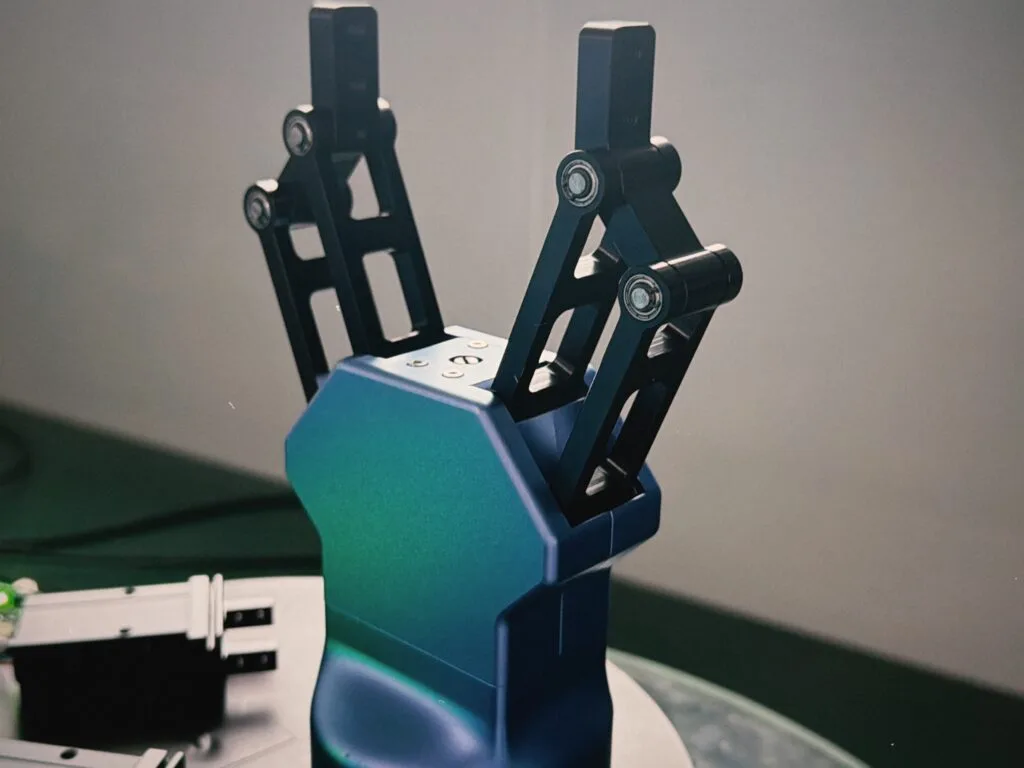
Where the answer is mechanical gripping, the tool usually has to be large: a wide opening to span the package and enough force to hold it against the worst acceleration in the cycle. That combination is what pushes the selection toward a heavy-load gripper rather than a general-purpose parallel tool.
Layer forming and placement accuracy
A pallet is not built one box at a time, it is built one layer at a time, and the accuracy requirement belongs to the layer. Within a layer, products are placed against each other, so a small error in the first placement propagates through the rest.
Two consequences follow. First, the datum matters: if each product is placed relative to the previous product, errors accumulate; if each is placed relative to the pallet datum, they do not. Second, release behaviour matters more than approach accuracy, because a product that is placed exactly and then dragged is worse than one placed approximately and left alone.
Where the pattern is tight, finger thickness becomes a real constraint. The fingers have to descend between products that are already in place, so the mechanical envelope they need is narrower than the gap in the finished stack. This is often the reason a station cannot use the tool that was otherwise the best match.
Reach, stack height and wrist load
Palletizing tends to push the arm to the outer edge of its working envelope, and that changes the load case compared with handling the same product at close range. Three effects compound as the stack grows and the reach extends.
- The moment arm increases. The same product weight produces a larger load on the wrist and on the gripper’s finger bearings when the arm is extended than when it is close in.
- Deflection becomes visible. Fingertip deflection under load translates directly into placement error at the far corner of the pallet, which is where misplacement is hardest to correct.
- Cycle time budget shrinks. Slower acceleration reduces the stability problem but costs throughput, so the tool has to hold the product at the speed the cell actually needs rather than at a comfortable speed.
This is the reason palletizing grippers are usually specified with more finger stiffness than the product weight alone would suggest, and why a long-finger tool that performed well in a test cell can behave differently on a full-height pallet.
Mixed SKUs and changeover
Few palletizing cells handle one product size for their whole life. What matters is how the cell absorbs the second and third product without a rebuild.
| Approach | What changes at the cell | Trade-off |
|---|---|---|
| Fixed fingers, single product | New fingers or a new tool | Simplest and stiffest, but every new product is a project |
| Programmable stroke and force | A recipe selected by product code | Covers variation within the finger range without mechanical work |
| Quick-change finger sets | Operator intervention, then a recipe | Widest product range, but the changeover is manual and can be missed |
| Two tools on a changer | Automatic tool exchange | Best range and no manual step, at the cost of a changer and floor space |
The failure that repeats across sites is a recipe system that exists but is never verified. If a recipe change can place a product wrongly and nobody checks the first layer, the error is only caught when the pallet is unstable. Where several products share one tool, the general logic for balancing stroke, force and finger design is set out in how to choose an electric gripper for a robot arm.
Cases and bags are two different problems
Cartons and bags get grouped together in palletizing discussions and they behave nothing alike. A carton is a rigid body with defined faces: the handling question is where to contact it and how much force it tolerates before the corners crush. A bag is a deformable mass with no fixed geometry: the handling question is how to support it so it does not sag, slip or lose its shape.
For cartons the useful approach is usually area handling, unless the carton is heavy, abrasive or exposed to conditions that rule vacuum out. For bags, the reliable method is usually to support the base rather than to grip the sides, either with a fork-style tool or with a clamp that closes under the bag. Trying to solve a bag with a conventional two-finger gripper generally ends in either a dropped product or a torn one.
Damaged and deformed packaging
Real production does not deliver ideal products. Cartons arrive dented, trays arrive with a crushed corner, and bags arrive with the fill distribution uneven. A cell that works only with perfect packaging produces a stop every time reality intervenes.
The practical test is to describe the worst product the cell must tolerate and design for that, not for the sample that was photographed. Two questions settle most of it: whether the product still presents a usable contact surface when deformed, and whether the handling method degrades gradually or fails abruptly. Gradual degradation — a vacuum leak that reduces margin — can be managed with feedback. Abrupt failure, such as a finger that no longer reaches a side wall, cannot.
Safety holding through fast moves
Where a cell stops unexpectedly, the gripper may be holding product in the air, and whether that product stays there depends on the mechanism rather than on the commanded force. A tool that releases when drive torque is removed will drop the product during an emergency stop regardless of what it can lift in normal operation.
For heavy or valuable products this is worth specifying explicitly with the cell integrator. The answer affects the gripper family, and it is far cheaper to settle during specification than to add a mechanical retention device afterwards. The underlying reasoning on how force requirements should be derived is set out in gripping force specification. Palletizing is also often the downstream step of a cell whose upstream step is machine tending, and that application has its own constraints, covered in CNC loading and unloading.
Frequently asked questions
Can an electric gripper palletize cartons?
Sometimes, but a clean flat carton is usually handled faster and more simply with area-based tooling. Mechanical gripping becomes competitive where the carton is heavy, has a usable side wall, or has a surface that vacuum does not seal against.
What matters more than gripping force?
Friction at the contact faces, how far apart the contact points are, the acceleration in the cycle and how the product deforms under load. Increasing force often makes a stability problem worse by crushing the product.
Can electric grippers handle battery modules on a pallet?
Yes, where the module presents a sound contact surface and the combined tool and product load is within the robot’s rating at the reach being used. Module palletizing is usually limited by wrist load and accuracy at full extension rather than by grip.
Is feedback useful for palletizing?
It is useful for confirming that a product was picked before the robot travels, which turns a dropped-product incident into a station alarm. It does not correct a placement error, so it complements rather than replaces accurate sequencing.
Why is my stack drifting out of alignment?
Check the datum first. If each product is positioned relative to the last one, errors accumulate across the layer. Placing every product relative to the pallet datum removes the accumulation.
What should be sent for a palletizing tool review?
Product dimensions, weights and surface condition, the worst damaged product the cell must tolerate, the stack pattern and target height, the robot model and reach, the required cycle time, and whether products must be held through power loss.
Image reference