On this page
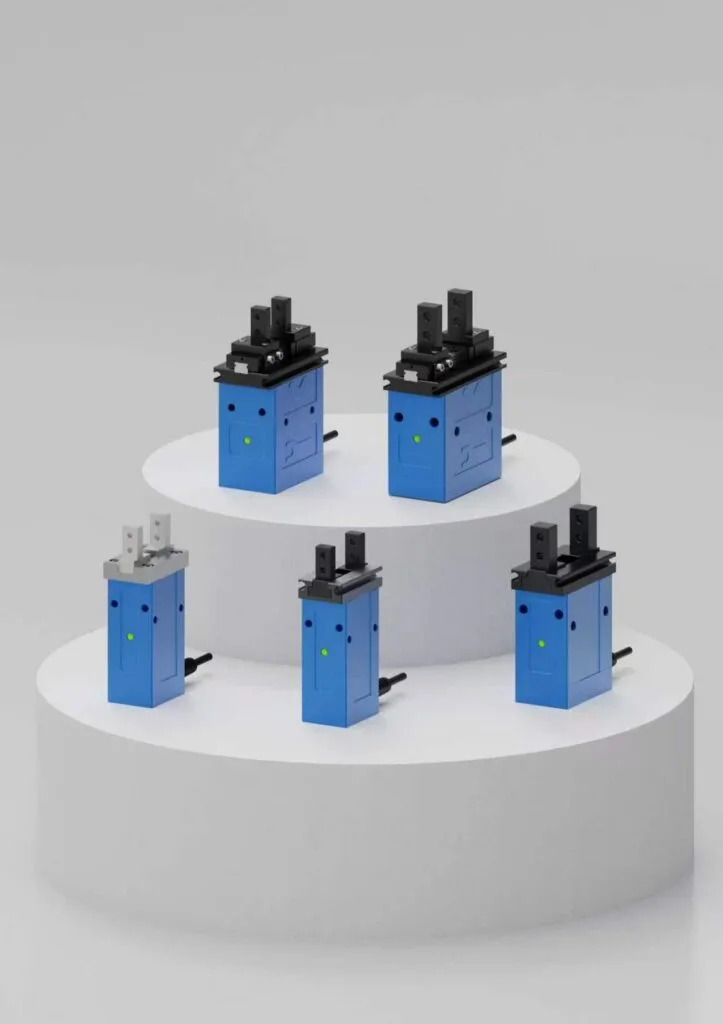
A parallel gripper closes two fingers in a straight line and keeps the gripping faces parallel. A 3-jaw gripper closes three fingers toward a common center. The part shape decides which one is correct.
Both are electric, both are widely used, and both appear in the same catalogs. The confusion usually comes from treating it as a performance question when it is really a geometry question.
How a parallel gripper works
Two fingers travel toward each other along a linear guide. Because the faces stay parallel, the contact area between finger and part does not change as the gripper closes.
That constant contact area gives several practical advantages:
- Predictable contact pressure, because the same area is loaded every cycle
- Finger design is straightforward for flat, parallel surfaces
- The same gripper accepts many different part sizes within its stroke
- Simple to fixture and simple to program
The limitation is alignment. A parallel gripper holds a part where the fingers meet it. It does not pull the part toward a center. If the part arrives slightly off-position, it stays slightly off-position.
How a 3-jaw gripper works
Three fingers move toward a common axis. This is a centering motion, not a clamping motion, and that distinction is what makes it useful.
- The part is pulled to a repeatable center as the jaws close
- A cylindrical surface is contacted at three points, which resists rotation and side slip
- Round parts are held more stably than with two flats
- Self-centering reduces the accuracy demanded from the upstream feeder
The cost is complexity. Three-finger mechanisms and finger sets are more application-specific, and the gripper usually suits a narrower range of part shapes than a parallel unit does.
Comparison
| Question | Parallel gripper | 3-jaw gripper |
|---|---|---|
| Part shape | Rectangular, prismatic, flat-faced | Round, cylindrical, ring-shaped |
| Centering | No — holds where the part already is | Yes — pulls the part to a center |
| Resistance to rotation | Depends on friction and finger shape | Higher, by three-point contact |
| Range of part sizes | Wide, within the stroke | Narrower; tied to diameter range |
| Finger design effort | Usually lower | Usually higher |
| Typical use | General pick and place, machine loading | Shafts, tubes, rings, centering tasks |
Let the part decide
A quick way to reach a direction:
- Are there two opposing flat surfaces to grip? A parallel gripper is the natural choice.
- Is the part round with no flats? Three fingers give a much more stable hold than two contact lines.
- Does position accuracy depend on the gripper? If the feeder is not precise, a self-centering 3-jaw motion can absorb that error.
- Is the part large or heavy? Check that the three-finger mechanism can deliver the required force, since centering designs are sometimes optimized for smaller parts.
- Will the same station run many different parts? A parallel gripper with a wide stroke usually changes over faster.
Finger design matters as much as the gripper
In most failing installations, the gripper was fine and the fingers were the problem. Points that are worth checking before committing:
| Point | What to consider |
|---|---|
| Contact surface | Flat, V-groove, or custom profile matched to the part |
| Material | Hardened steel for wear, softer materials to protect the part surface |
| Reach and stiffness | Long fingers flex and lose position accuracy under load |
| Clearance | Fingers must clear fixtures, tooling, and the machine opening |
| Wear parts | Replaceable pads or inserts reduce long-term maintenance |
Frequently asked questions
Can a 3-jaw gripper hold a square part?
It can, but the three contact points will not be symmetrical on a square, so the hold is less balanced than with a parallel gripper. It is done when the part also needs centering, but it is not the first choice.
Is a 3-jaw gripper always better for round parts?
Usually yes, because three points define a center and resist rotation. If the part has a flat section, or if it only needs to be picked from one known side, a parallel gripper with shaped fingers can also work.
Which type is more repeatable?
Repeatability depends far more on the mechanism quality and the finger stiffness than on the number of jaws. A well-built parallel gripper will outperform a poorly built 3-jaw unit, and the reverse is also true.
Can the same gripper do both?
Not directly. The finger count and motion geometry are fixed in the mechanism. Some parallel grippers accept different finger sets to handle a wider range of shapes, but they still do not self-center.
What about a 2-jaw angular gripper?
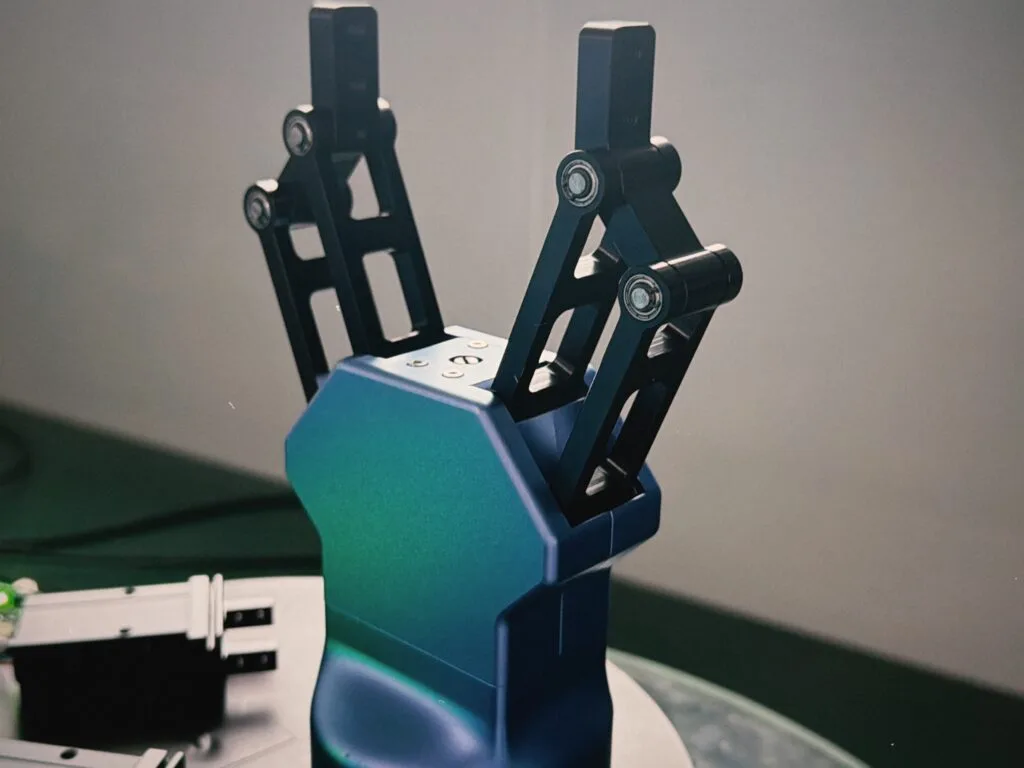
It sits between the two. The fingers pivot instead of sliding, which can reach into tighter spaces and grip parts that are wider than the gripper body, but contact angle changes as it closes, so force and alignment need more attention.
Need help selecting a gripper?
Send your part drawing, robot model, required stroke, clamping force, country, and quantity for a practical model shortlist.
Image reference