On this page
A robot gripper is the end-of-arm tool that physically holds a workpiece during an automated process. It mounts on a robot arm, a cobot, a linear axis, or a custom handling machine, and it is the only part of the cell that touches the product.
That last point matters more than it sounds. Robot payload, cycle time, part surface quality, and line uptime are usually decided by the gripper, not by the robot. Two grippers that look almost identical in a catalog can behave completely differently on the same arm.
What a gripper is actually asked to do
Most selection discussions start with “open and close”. In production, the gripper is asked to do several things at once:
- Hold the part through motion. Acceleration, deceleration, and vibration all add load the static part weight does not show.
- Place the part, not just grip it. A part can be held securely and still be placed in the wrong position.
- Limit contact force. Thin housings, coated surfaces, and soft materials can be marked or crushed by a gripper that only knows “closed”.
- Report status. A signal telling the PLC whether the part is present and where the fingers are prevents the next cycle from running blind.
- Orient the part. A rotating gripper can often replace a second wrist axis or a re-orientation station.
Main types of robot grippers
| Type | How it holds | Typical parts |
|---|---|---|
| Parallel gripper | Two fingers close in a straight line, keeping faces parallel | Blocks, plates, housings, machined parts |
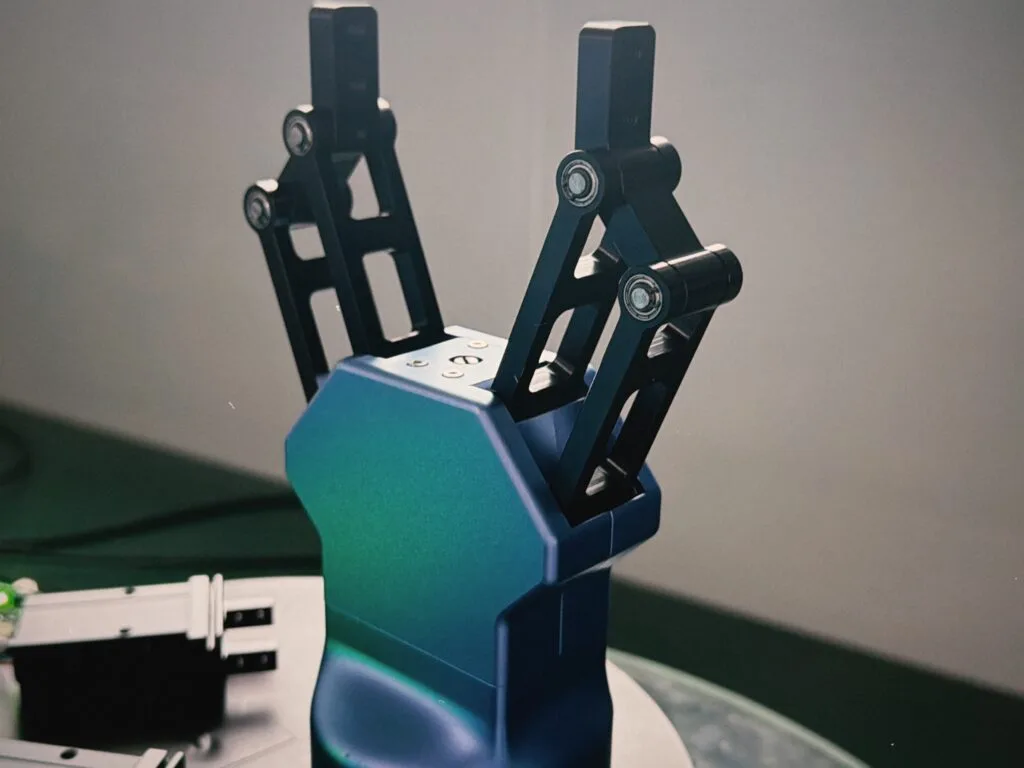
| Angular gripper | Fingers pivot around a joint | Parts needing a wider opening angle in tight space |
| 3-jaw gripper | Three fingers close toward a common center | Shafts, tubes, rings, cylindrical parts needing centering |
| Vacuum gripper | Suction cup on a flat, non-porous surface | Sheet, glass, film, flat panels |
| Magnetic gripper | Magnetic field on ferrous parts | Steel plate and stamping where one face is free |
| Soft gripper | Compliant fingers conform to the shape | Fragile or irregular items in low-force handling |
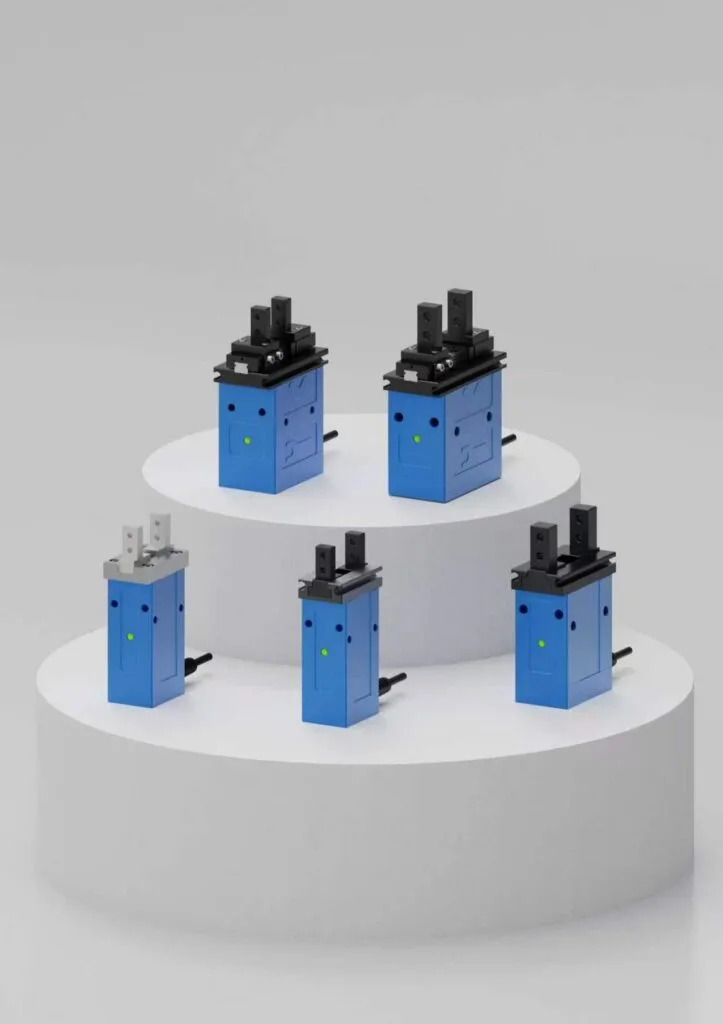
Parallel and 3-jaw electric grippers cover the largest share of industrial handling work, which is why most selection conversations end up comparing those two.
Electric gripper or pneumatic gripper?
Pneumatic grippers are simple and fast, and they remain a reasonable choice when the part is consistent, the required force is not sensitive, and the plant already has a stable compressed-air system.
Electric grippers become the better direction when the process needs something the air cylinder cannot give: adjustable stroke or force set from the program, position feedback, status reporting, or multiple product sizes running on one line without mechanical changeover. They also avoid the valves, tubing, regulators, and air preparation that a pneumatic cell requires.
The decision is best made from the handling task rather than from a preference for one technology.
What to prepare before asking for a quote
| Input | Why the supplier needs it |
|---|---|
| Part drawing or photo | Defines contact surfaces and finger shape |
| Part weight | Drives clamping force and safety margin |
| Gripping width, open and closed | Sets the required stroke range |
| Robot or cobot model | Determines payload headroom, flange, and mounting space |
| Cycle time target | Affects speed, force, and whether the gripper can keep up |
| Communication method | Decides how the gripper talks to the controller: I/O, RS485, Modbus, or a fieldbus |
| Environment | Coolant, chips, dust, or washdown change the ingress protection required |
| Annual quantity | Separates a prototype build from a repeat production order |
With these inputs, a supplier can narrow the range to two or three models instead of listing the whole catalog.
Mistakes that show up after installation
- Selecting on stroke alone. Jaw opening is the easiest number to compare and the least important one on its own.
- Ignoring dynamic load. A gripper that holds a part on the bench may drop it at full arm speed.
- Forgetting finger design. The fingers are what actually touch the part. A good gripper with poor fingers still fails.
- Overlooking cable routing. Cables that rub or bind at the wrist fail long before the gripper does.
- No force margin. Sizing exactly to the calculated minimum leaves nothing for surface variation or wear.
Frequently asked questions
Is a gripper the same as an end effector?
An end effector is the general term for anything mounted on the robot flange — grippers, suction cups, welding torches, and dispensers. A gripper is one type of end effector specialized for holding parts.
Can one gripper handle several product sizes?
Often yes, if the stroke range covers the smallest and largest part, and if the force can be set per product in the program. That is one of the practical advantages of an electric gripper over a fixed pneumatic one.
Does gripper weight matter on a cobot?
More than on an industrial robot. On a cobot, every kilogram of tool weight comes off the usable payload, which directly reduces the part weight the arm can carry. Compact, lightweight tools are usually preferred at the wrist.
How many fingers do I need?
Two parallel fingers handle most prismatic parts. Three fingers help when the part is round or needs self-centering. The part shape and available gripping surfaces decide this, not the gripper category.
Need help selecting a gripper?
Send your part drawing, robot model, required stroke, clamping force, country, and quantity for a practical model shortlist.
Image reference