The how many jaws gripper question is settled by part shape, not by a preference for more contact. Two jaws suit a prismatic part with two opposing flats, three jaws make a round or hexagonal part centre itself, and four jaws are the answer when a wide, thin or rotation-sensitive part needs its load spread. Every extra jaw adds one contact point, and a contact point is a constraint: useful on some parts, harmful on others.
Most how many jaws gripper decisions are made from a catalogue rather than from a drawing. A mechanism with more fingers looks stronger, so it is shortlisted first and the part is made to fit the choice. The order is backwards: contact geometry decides what the part does when it is gripped, and the mechanism, the finger set and the spares all follow from that.
On this page
Why the how many jaws gripper question is decided by part shape
A jaw is a constraint. Each one removes a freedom from the part or shares the load that holds it, and how many constraints a part can usefully accept depends on how well it is made and how it arrives at the station. The how many jaws gripper answer follows from that count, not from the mechanism catalogue.
- Two points hold, they do not locate. Two pads on opposing faces stop movement on one axis and give nothing against rotation.
- Three points locate a round part. Three pads on a cylinder define a centre, so the part is pulled to the same place every cycle.
- Four points resist rotation. A fourth pad takes away the rotation that two or three points leave free.
- Every added constraint has to be satisfied. If the part is not as square as the finger set assumes, one pad carries nothing and the load lands on the others.
Sketch the pads on the part and count how many can touch at once within the part tolerance. If that is fewer than the number of fingers, the how many jaws gripper choice is already wrong.
What one contact point actually contributes
In any how many jaws gripper comparison, each contact point buys one property and charges one cost. The gripper finger count is therefore a load-sharing decision as much as a geometry decision, and the table below reads from two points upward.
| Contact points | What the extra point buys | What it costs |
|---|---|---|
| Two | Grip on one axis, wide size range in the stroke | No centering, no rotation resistance |
| Three | Centering, rotation resistance on a round part | Finger geometry tied to a diameter band |
| Four | Rotation resistance on a flat part, lower stress per pad | More mass, four fingers to make and replace |
| Five and above | Load spread on large or thin parts only | Complexity that rarely pays on small parts |
Contact count also changes where the force goes. Two pads pass the closing force through two areas, so surface pressure is high and the friction resisting slip is concentrated. Four pads spread the same force over four areas, which lowers pressure and makes ovalising a thin part less likely. That mechanism sits behind most how many jaws gripper recommendations, even when the advice is only about shape.
The trade is not free. Friction per pad falls as pads multiply, so a heavy part held by friction alone can slip in a four finger set that would have held it in a two finger set.
Two jaws: when two contact points are enough
A two jaw gripper closes two fingers along a line or pivots them toward each other. The contact faces stay in a known relationship, so finger design is simple and the usable size range is usually the widest of any layout — which is why the how many jaws gripper answer is often two.
- Parts with two parallel faces. Blocks, brackets, plates and housings the feeder can present with two opposing surfaces exposed.
- Wide size variation at one station. Stroke is not tied to a diameter, so one body covers a part family.
- Low mass. Two fingers weigh less than three or four, which matters on small robots and tight payload budgets.
- Simple spares. Two fingers are quicker to make, fit and stock.
The limits of this how many jaws gripper answer are as clear. A two jaw gripper holds the part where it already is, so accuracy is inherited from the feeder. If nothing else constrains rotation, a round part will turn between the pads under a side load.

Three jaws: self-centering for round and hexagonal parts
A three jaw gripper moves three fingers toward a common axis, so closing centres the part while it grips. It is the how many jaws gripper answer for anything round, and this is the layout that removes positional error instead of passing it on.
Review EPG3-10-50 electric gripper using its documented three-finger layout and the contact geometry of the actual part. Request confirmed force and load data before matching it to an application.
- Shafts, rings, bushes and tubes. Three pads on a cylinder define a centre and resist rotation far better than two.
- Hex fittings. Three pads land on alternating flats, which is positive location rather than a friction hold.
- Imprecise feeders. Self-centering absorbs presentation error, so the robot need not be taught around it.
The cost is finger work. A three jaw gripper is usually built for a diameter band, so a change of part family often means a change of fingers. Where one station runs round and flat parts, a two jaw layout with shaped fingers is often calmer, as the parallel gripper versus 3-jaw gripper comparison sets out.
Four jaws and beyond: where the extra fingers earn their keep
A four jaw gripper is worth its complexity when the part is large, flat and thin, or when two independent axes of grip are needed. On small solid parts the fourth finger adds mass without adding control.
- Panels and sheet parts. Four pads near the corners hold a flat part without bowing it.
- Thin-wall tubes and rings. Spreading the force lowers surface pressure, which keeps a thin wall from going oval.
- Parts that must not rotate. A square block gripped on four sides is located against rotation without friction.
- Independent jaw pairs. Some designs let pairs move separately, so a part can be gripped off-centre on purpose.
Beyond four, the how many jaws gripper returns fall away quickly. Large thin tubes sometimes justify six pads, but each addition multiplies the finger sets in stock and the alignment work at changeover. A how many jaws gripper review that reaches five or more should name the specific failure it prevents.
Matching part shape to jaw count in a how many jaws gripper review
This table is the fast route from a part drawing to a starting layout. Treat it as a starting point and confirm the last column.
| Part and presentation | Starting count | Why | What to confirm |
|---|---|---|---|
| Machined block, two flat faces | Two | Wide stroke, simple fingers | What sets rotation |
| Shaft fed on a conveyor | Three | Self-centering absorbs feeder error | Diameter band of the family |
| Hex fitting from a bowl feeder | Three | Pads land on alternating flats | Flat width versus pad width |
| Thin panel, cosmetic face out | Four | Lower pressure per pad, less bowing | Pads against support points |
| Thin-wall tube | Three or four | Force spread limits ovalising | Closing force versus wall |
| Square block, no rotation allowed | Four | Positive location on four sides | Corner clearance |
Clamping force and centering accuracy pull in different directions
Closing force and centering accuracy are usually discussed as if one decision produced both. They do not, and this is where the how many jaws gripper argument usually starts. Force depends on the mechanism ratio and the drive; centering depends on how many contact points define the part’s position.
| Behaviour | Two jaws | Three jaws | Four jaws |
|---|---|---|---|
| Centering | None | By geometry | Partial, linkage dependent |
| Pressure at the surface | Highest | Moderate | Lowest |
| Rotation resistance | Needs shaped fingers | Good on round parts | Good on flat parts |
| Deformation risk, thin parts | Highest | Moderate | Lowest |
| Friction per pad | Highest | Moderate | Lowest |
Read across rather than down. A heavy part that is easy to locate wants the friction of two pads plus a positive stop elsewhere in the cell. A light but slippery part wants three or four pads, so slip is resisted by geometry rather than friction — a distinction that decides more how many jaws gripper cases than any force figure on a datasheet.
Thin-wall and fragile parts: spreading the load
On a thin-wall part the limit is surface pressure, not grip force. Each pad presses on a small area and the wall behind it has nothing to push against.
- Add pads before adding fingers. A wider or conforming pad spreads the same force over more area, often without changing the mechanism.
- Match pad shape to the part. A pad machined to the local radius touches along a line; a soft conforming pad touches over an area and is gentler.
- Keep pads off unsupported spans. A pad over a free span bows the wall inward; the same pad over a rib barely disturbs it.
- Four pads for panels, three for tube. Panels need corners held, tubes need the force spread around the circumference.
Closing force still needs margin for the surface finish and the acceleration of the move. The wider sequence sits in the electric gripper selection guide, and the how many jaws gripper step is the one most often skipped.
Long parts and overhang: why extra jaws do not fix flex
A long part gripped at one end behaves like a beam. Grip point position sets how far the free end deflects; finger count does not. Adding a fourth finger that grips in the same place changes almost nothing about tip deflection, which is why the how many jaws gripper count is the wrong lever on a long part.
- Move the grip, not the count. Bringing the grip closer to the centre of mass reduces the moment more than any change of finger count.
- Support, do not squeeze. A rest or steady in the cell controls a long part better than a stiffer grip.
- Lengthen the pad, not the set. A longer contact resists rotation about the pad itself, which is what matters on a slender part.
- Watch tool mass. Extra fingers push the centre of mass away from the flange and eat payload.
Stability on a long part is largely a stiffness question, covered in the robot gripper finger design guide.
Stroke and opening range limit the jaw count you can use
Fingers need room, and that is the least visible limit on the how many jaws gripper decision. On a body of a given size, three or four fingers sit closer together than two, which leaves less travel for each finger and often forces a wider body to recover the opening range.
- Opening range versus stroke. Jaw count sets the minimum opening, so a larger count tends to narrow the part family one body can cover.
- Finger section. Three or four fingers must share a guide, so the section is thinner and the pads sit further from the palm.
- Size to the part. Pick a body that covers the largest part with margin, then check the smallest still fits between the pads.
For EPGS-12P-15 electric gripper, request the current body envelope, opening definition and fingertip-interface drawing, then check the proposed fingers against the part. Where a how many jaws gripper decision must cover several part sizes at one station, checking opening range early avoids a station rebuild.
Changeover and spare fingers in the how many jaws gripper decision
Finger count also shows up on the maintenance side, and it is the part of a how many jaws gripper review that gets skipped. More fingers means more parts to align, more pads to inspect and a larger set to hold in stock.
| Jaw count | Fingers per set | Typical attention point | Spare strategy |
|---|---|---|---|
| Two | Two, often mirrored | Pad wear on the leading edge | One spare set |
| Three | Three, matching | Pad contact and synchronisation | One set per diameter band |
| Four | Four, often paired | Pair alignment and equal preload | Sets per part family |
Changeover follows the same pattern. A two finger set swaps and re-teaches quickly, while a four finger set with paired jaws needs alignment before the first part runs. Where a station changes parts weekly, the number of fingers to change belongs in the comparison alongside the grip itself.
Wear is worth a thought at the design stage too. Replaceable pads let a worn contact area be renewed without machining new fingers, which is worth more on a four finger set simply because there are more pieces to reproduce.
What the extra finger costs over the life of the cell
Unit cost is the smallest part of the how many jaws gripper difference. The larger effects are mass at the tool, engineering time and what has to be kept on the shelf.
- Mass and cycle time. Fingers sit at the end of the kinematic chain, so every gram is paid for on every move, all shift.
- Engineering time. Each finger profile is a design task with its own pads, clearances and first-article check.
- Inventory. Spare fingers and pads multiply with jaw count, and a part family multiplies again.
- What it prevents. Fewer rejected parts and less manual recovery can outweigh all of the above, and that is the only justification that holds.
Stated plainly: a fourth finger is worth having when a named failure disappears because of it. That test settles most how many jaws gripper arguments faster than any comparison table.
Worked example: how many jaws gripper answers for three parts
The following is illustrative and is not a specification for any model. Three parts arrive at one cell, and each points at a different layout.
| Part | Layout that fits | Reason |
|---|---|---|
| Machined bracket, two flat faces | Two jaws, shaped pads | Prismatic, wide size range, no centering needed |
| Steel shaft from a gravity chute | Three jaws | Round part, loose feeder, rotation risk |
| Thin coated panel, cosmetic face | Four jaws, soft pads | Low pressure needed, rotation must be blocked |
Read together, the three rows show why one gripper rarely covers a mixed station. The bracket would be over-constrained by four fingers, the shaft would not be centred by two, and the panel would be marked by either. Splitting the station into two grippers is often cheaper than forcing one mechanism to cover all three, and that is a legitimate outcome of a how many jaws gripper review rather than a compromise.
Checklist before the how many jaws gripper decision is signed off
- Sketch the pads on the part. Confirm all fingers can touch at once within the part tolerance.
- Name what sets position. If the gripper is not centering, something in the cell must locate the part.
- Name what blocks rotation. Friction, a shaped pad or a fourth finger — pick one and test it against the worst side load.
- Check pressure, not only force. Divide closing force across the pads and compare with what the surface can take.
- Confirm the opening range. Check the smallest and largest parts both fit with the chosen jaw count.
- Count the fingers you will maintain. Multiply by the part families at the station and judge whether spares are realistic.
Answer those six points and the how many jaws gripper choice is usually already decided, because the part has done most of the work. Anything still open is a cell question rather than a gripper question, and it is cheaper to settle before the drawing is issued.
Frequently asked questions
How many jaws should a gripper have for a round part?
Three, because three pads on a cylinder define a centre and resist rotation. Two jaws can hold a round part when it has a groove for the pads, but the cell then has to supply the position and the rotation stop.
Is a 4 jaw gripper always better than a 2 jaw gripper?
No. Four jaws lower the pressure per pad and block rotation on flat parts, which matters on panels and thin walls. On a small solid part, two jaws with well-shaped pads are lighter and simpler, and the extra fingers add mass and spares without improving the hold.
Can a 3 jaw gripper hold a square part?
It can, but the three pads land asymmetrically on a square, so the hold is less even than with four. It is done when the part also needs centering, and shaped pads help, but four jaws or two jaws with a positive stop usually fit better.
Do more jaws mean more gripping force?
Not directly. Closing force comes from the mechanism and the drive; jaw count changes how that force is distributed. An extra finger lowers the force per pad and spreads it over more area, so surface pressure falls rather than total hold rising.
How do I judge how many jaws gripper designs need when the part is mixed?
Split the part family by how each part must be located rather than by size. If two groups need different location, the how many jaws gripper answer differs between them, and two grippers or two finger sets usually cost less than one compromise.
Need help selecting a gripper?
Send your part drawing, robot model, required stroke, clamping force, country, and quantity for a practical model shortlist.
Compare jaw layouts
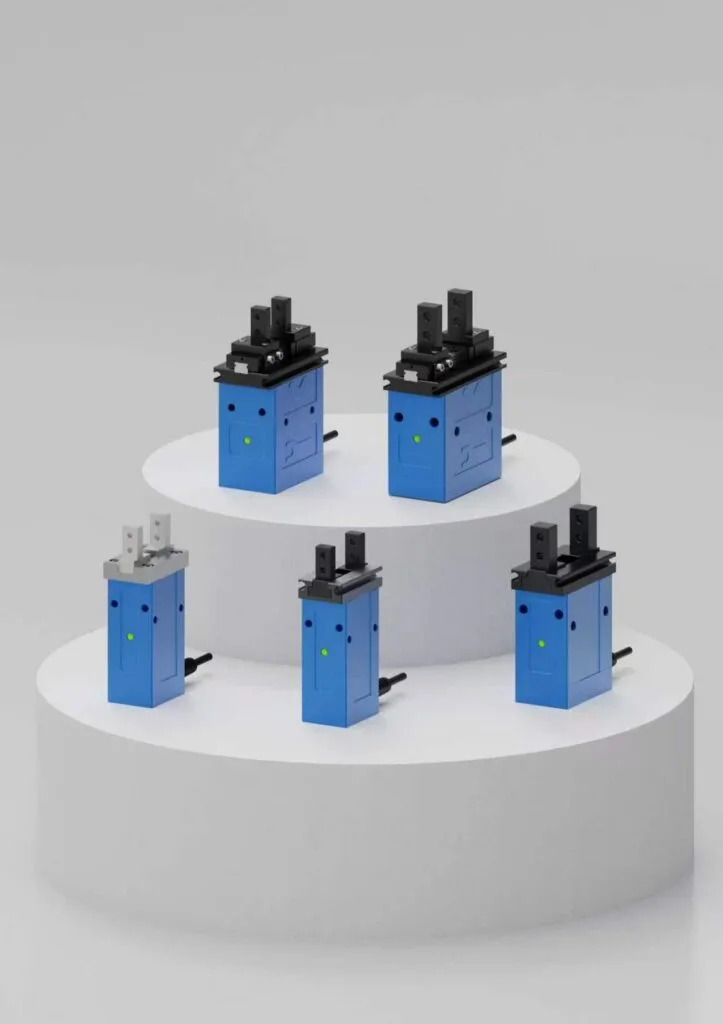
Compare the two-finger EPG2-26-50, three-finger EPG3-10-50 and four-finger EPG4-10-50. Check part contact and the stated stroke definition for each.