On this page
A good cobot gripper for small parts is light, compact, repeatable, and gentle enough to handle parts that are easy to damage. On a cobot, those four requirements are not independent — they trade against each other, and that trade is what makes the selection harder than it looks.
Small parts handling covers a wide range: connectors, small housings, lenses, sensors, PCB assemblies, and machined components. What these have in common is low mass, often a delicate surface, and a station that has to stay flexible.
The cobot constraint that changes everything
An industrial robot usually has payload to spare. A cobot does not, and this reshapes the whole selection.
| Constraint | Consequence for the gripper |
|---|---|
| Rated payload includes the tool | Gripper weight and fingers come directly off the part weight the arm can carry |
| Wrist is small and close to the work | A bulky gripper reduces reach and can collide with fixtures |
| Collaborative operation | Sharp edges and pinch points matter more than on a fenced cell |
| Redeployment is expected | The gripper should be quick to mount, re-cable, and re-teach |
| Often programmed by operators | Force and position should be simple to set, not buried in a controller menu |
This is why an integrated electric gripper — one with the drive and control inside the body — is usually preferred at a cobot wrist. It removes the controller box and reduces what has to be routed along the arm.
Why small parts often favour electric gripping
- Force limiting. A controlled maximum force protects surfaces that a standard pneumatic gripper would mark on contact.
- Position feedback. The controller can confirm that the fingers reached the expected position, which is effectively a presence check.
- Programmable stroke. One station can run several part sizes without mechanical changeover.
- Quiet, clean operation. No exhaust air, which matters in electronics and inspection areas.
- Compact integration. Fewer external components on a wrist that has little room.
What to measure before choosing
| Input | Why it drives the decision |
|---|---|
| Part weight and size | Sets the payload requirement once tool weight is subtracted |
| Gripping location and allowed contact area | Determines whether standard fingers work or custom fingers are needed |
| Surface sensitivity | Decides pad material and whether force must be limited |
| Position accuracy required | Separates “hold the part” from “place the part” requirements |
| Cycle time | Affects both gripper speed and the arm’s usable acceleration |
| Number of product variants | Justifies programmable stroke and force, or rules it out |
| Cobot model | Fixes the flange, payload, and available mounting space |
Matching the direction to the task
| Task | Gripper direction | Reason |
|---|---|---|
| Pick and place flat parts into trays | Compact parallel, short stroke | Stable hold, minimal wrist load |
| Handling small cylindrical parts | Parallel with V-groove fingers | Centers the part without a 3-jaw mechanism |
| Connector insertion | Parallel with limited force | Force control prevents damage on seating |
| Testing and inspection stations | Parallel with position feedback | Confirms presence and grip position each cycle |
| Mixed product families | Parallel with wide stroke and set per product | Changeover becomes a parameter change |
| Fragile or coated surfaces | Soft pads, limited force | Contact pressure stays within what the surface accepts |
Cable routing and fingers — where cobot cells fail
Two details cause more downtime on cobot cell retrofits than the gripper itself:
- Fingers. Because small parts need precise contact, the fingers are usually custom. Their stiffness matters — long, thin fingers flex under load and silently lose placement accuracy. Replaceable pads on the contact face reduce long-term maintenance.
- The cable at the wrist. A cable that binds or rubs through a full wrist rotation fails in weeks. Route it with a service loop, secure it close to the flange, and check the full range of motion before production starts.
Signs a gripper is a poor fit for a cobot
- Requires a separate controller box that has to be mounted somewhere on the arm or nearby
- Fingers cannot be changed without dismantling the gripper
- Force adjustment requires mechanical work rather than a setting
- Weight and body size leave little usable payload or reach
- Communication requires a fieldbus the cobot controller does not support
Frequently asked questions
How much payload does a cobot gripper consume?
All of it counts — gripper body, fingers, mounting adapter, cable, and the part. On a cobot with a modest payload rating, a heavy metal gripper can consume a substantial share before any part is picked up. This is the main reason lightweight, integrated grippers are preferred.
Do I need a 3-jaw gripper for small round parts?
Usually not. Small cylindrical parts are often handled well by a parallel gripper with V-groove fingers, which centers the part without the extra mechanism and weight of a three-finger design.
Is force control necessary for small parts?
It depends on the part. Rigid metal components tolerate a wide force range. Plastics, coated parts, lenses, and thin-walled housings often need the force capped, which is where an electric gripper earns its cost.
Can one gripper handle a whole product family?
Often yes, if the stroke range covers the parts and the force can be set per product in the program. This is one of the strongest arguments for electric gripping in high-mix, low-volume production.
How do I know the part is actually gripped?
Use the position feedback from the gripper. If the fingers reach the expected position, the part is present and correctly sized; if they close further than expected, the grip is empty. This replaces a separate presence sensor in many small-part stations.
Need help selecting a gripper?
Send your part drawing, robot model, required stroke, clamping force, country, and quantity for a practical model shortlist.
Image reference
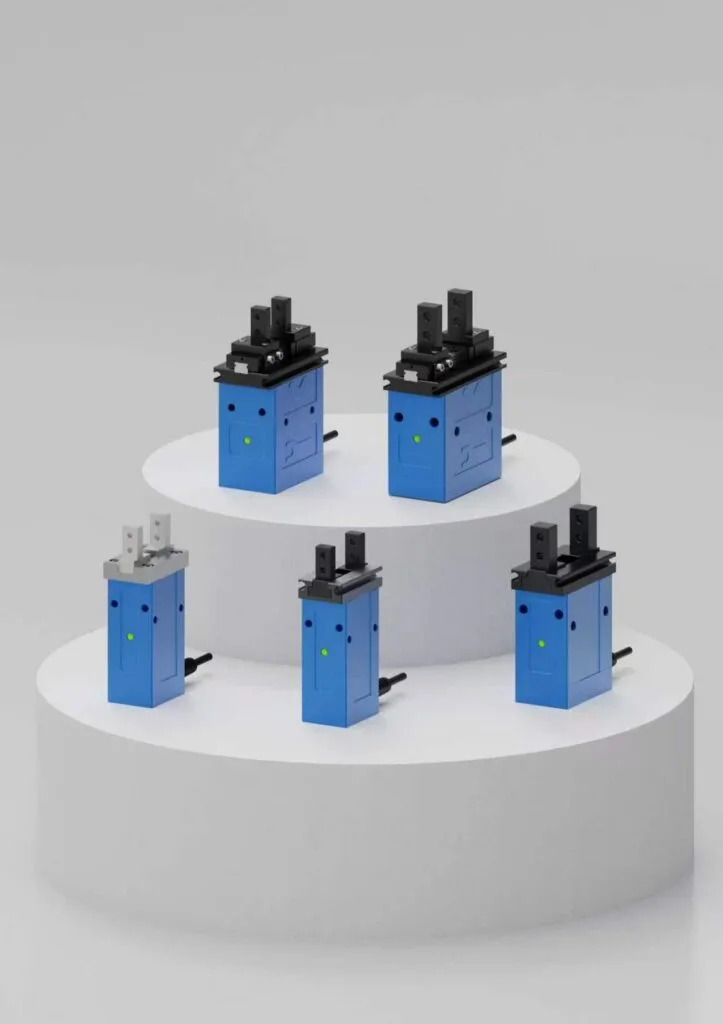
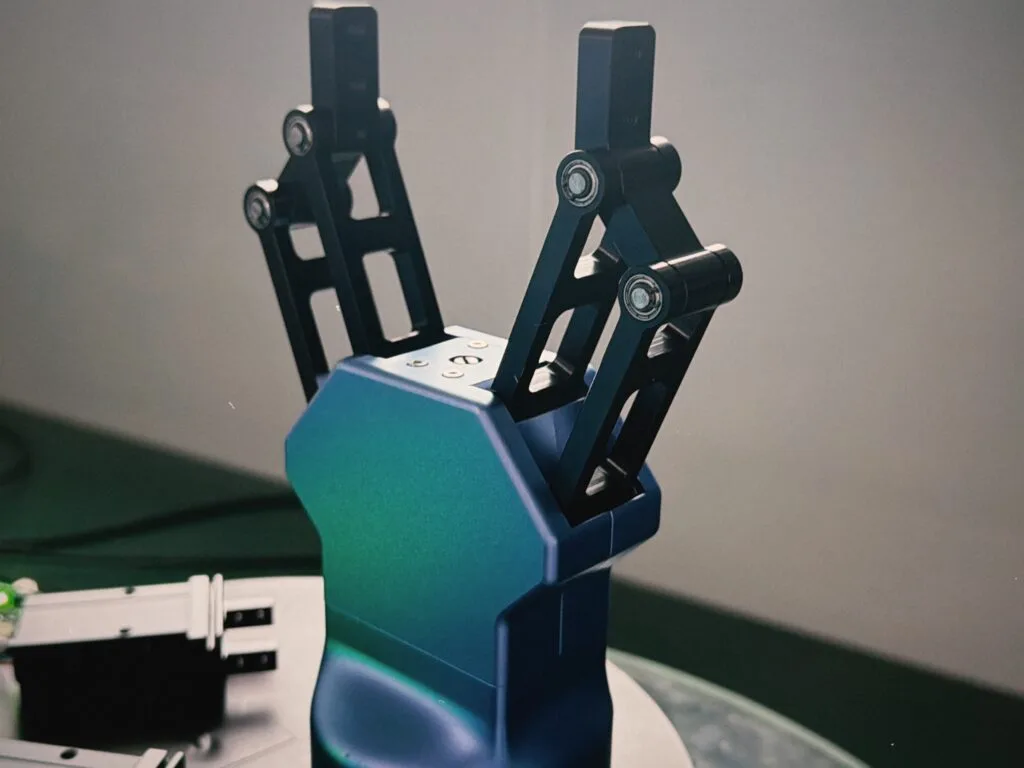
Two models to compare for collaborative robots
EPGC-50-150 lists 50 mm stroke, 3 kg maximum recommended clamping load, 40–150 N sustained force and IP54. EPG2-100-50 lists 100 mm stroke, 2 kg maximum recommended clamping load and 15–50 N force. Review the combined gripper, finger and part mass against the robot payload.