On this page
In battery assembly, an electric gripper is a positioning device first and a holding device second — the repeatability with which it places a cell, module or connector decides whether the cell runs, not the force it can apply. Most battery assembly specifications that go wrong start with a force number and never ask what the placement tolerance actually is. On a module line the difference between a cell that works and a line that stops every few hundred cycles is usually a fraction of a millimetre, and no amount of gripping force buys that back.
Battery assembly also sits in an awkward place between two other applications. It is not pure handling, where the part only has to arrive somewhere intact, and it is not precision electronics placement, where forces are measured in single newtons. Modules are heavy, cells are delicate on one face, and the same tool frequently has to cover several product formats. Those three constraints pull in different directions, so the selection has to be made with all of them on the table at once. Upstream of assembly, the handling and weighing stages have their own requirements, covered in electric grippers for battery handling and weighing.
Assembly is a placement problem before it is a holding problem
Handling asks one question: did the part arrive. Assembly asks a harder one: did it arrive in the right place, in the right orientation, without being damaged on the way, and can the line prove it. The gripper contributes to all four, but its dominant contribution is to the third and fourth questions through repeatability and feedback rather than through force.
The practical consequence is that two grippers with identical force and stroke ratings can give completely different assembly results. The difference is usually jaw guidance, how the fingers are located relative to the tool flange, and whether the gripper reports a position that the cell controller can trust. None of those appear in a force figure. The wider picture of how these parameters interact is set out in how to choose an electric gripper for a robot arm.
Where electric gripping earns its place on a battery line
Not every station on a battery line needs the same tool. Mapping the station before selecting anything prevents the two most common errors: fitting a programmable gripper where a simple one would do, and fitting a fixed-force tool where the part needed a force window.
| Station | Dominant requirement | Why electric actuation fits or does not |
|---|---|---|
| Cell pick from tray and place into module | Placement repeatability, low contact force on the cell face | Fits well — force and position can be set per cell format without mechanical change |
| Module lift and transfer to pack | Payload, load moment, safety holding | Fits if payload and wrist load are checked; force control matters less than stiffness |
| Spacer, insulator and thermal pad placement | Very low force, flat contact | Fits only with soft pads and a limited force window; area handling is often better |
| Connector and busbar insertion | Orientation, alignment, controlled insertion path | Fits with rotation or a compliance device; the gripper alone rarely completes the insertion |
| Fixture and carrier handling | Durability, cycle count | Fits, but this is the station least likely to need programmable force |
| High-speed small-part feed | Cycle time, presentation | Often a poor fit — vacuum or dedicated feeders usually win |
The last row matters. A meaningful share of battery assembly stations that get specified as gripper applications turn out, on inspection, to be feeding problems. The gripper is not the constraint, and buying a better one does not move the cycle time.
Repeatability is the number that actually describes the job
Repeatability and accuracy get used interchangeably in specifications and they are not the same thing. Accuracy describes how close the tool gets to a commanded target. Repeatability describes how consistently it returns to the same place. Assembly cares overwhelmingly about the second.
A cell placement station can tolerate a small, consistent offset, because the offset is absorbed once when the cell is taught and never appears again. It cannot tolerate scatter, because scatter is what puts a cell against a module wall on one cycle and half a millimetre clear on the next. When a buyer asks for a tighter tolerance, the useful question is whether the variation is systematic or random — they need different answers.
| Source of variation | Systematic or random | Usual fix |
|---|---|---|
| Tool frame not re-taught after a change | Systematic | Re-teach the tool frame as part of the changeover procedure |
| Adapter runout between flange and gripper | Systematic | Indicate the adapter; a machined adapter beats a shimmed one |
| Finger wear on the contact face | Slowly systematic | Treat fingers as a wear part with a measured replacement interval |
| Part not seated against a hard stop | Random | Add a locating feature or a compliant seating action |
| Fixture wear or debris in the nest | Random | Clean and inspect the fixture, not the gripper |
| Gripper body thermal drift over a shift | Slowly systematic | Allow a warm-up cycle; verify with a first-off inspection |
Note that most of the list is not the gripper. This is a common and expensive misdiagnosis on battery lines: a placement problem gets escalated as a gripper problem, and the replacement tool behaves exactly like the old one because the variation came from the adapter or the nest.
Fixtures carry more of the assembly accuracy than the gripper does
A good fixture guides the part into position and forgives a few tenths of a millimetre of robot error. A poor fixture demands that the robot be perfect, and no robot is. On battery lines, the fixtures that work share a few properties: a lead-in chamfer or funnel that converts position error into a sliding correction, a hard stop that defines the final position in one axis, and enough clearance that the gripper can release without dragging the part out of place.
The release motion deserves more attention than it usually gets. Many batteries are placed to a soft or compressible interface, and if the fingers retract while still loaded, they pull the part off its seat by exactly the amount the finger contact deflected. Releasing after the part is supported by the nest, rather than before, removes the problem entirely.
Connector and busbar insertion is a separate problem
Insertion looks like a natural extension of gripping and behaves quite differently. The gripper has to hold the part through a controlled approach, keep it aligned as it enters, apply or allow an insertion force, and then let go without disturbing what it just seated.
- Alignment is usually the binding constraint. Where the insertion axis and the robot approach axis disagree by more than a small angle, the part will bind regardless of force. Either re-teach the approach or add a compliance element that allows the part to find the axis.
- Rotation changes the tool count. If the connector has to be oriented before insertion, a rotating electric gripper can combine grip and orientation in one tool path, which often removes a separate rotary axis from the station.
- Force control does not equal force measurement. A gripper that can be commanded to a force is not automatically a gripper that can confirm the insertion force. If the assembly needs a pressing force recorded for process control, that is a different requirement and should be stated early.
One tool, several module formats
Battery products change faster than the equipment that makes them. A line specified for one module format is often asked to run two or three within a year, and the tooling decision made at commissioning decides how painful that is.
| Changeover approach | What has to change at the line | Practical consequence |
|---|---|---|
| Fixed fingers, one format | New fingers or a new tool | Cheapest at commissioning, most disruptive later |
| Programmable position and force | Recipe loaded in the controller | Handles size variation without a mechanical change, within the finger range |
| Wide stroke with adaptive fingers | Recipe, sometimes finger pads | Covers the widest format range but adds wrist mass and finger compliance |
| Quick-change finger sets | Operator intervention at the cell | Simple and predictable, but adds a manual step and a mismatch risk |
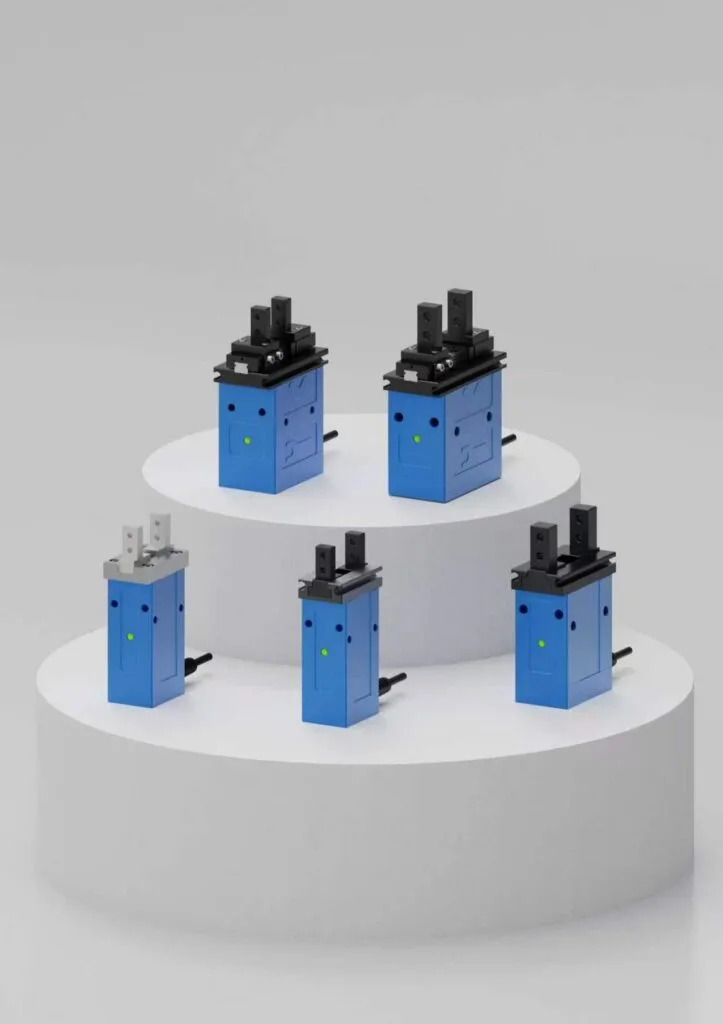
The mistake to avoid is designing the fingers around the format in the first photograph. The gripper has to survive the largest and the heaviest part in the family, and the smallest part in the family frequently turns out to be the harder one, because it is the one that can be gripped with the least margin. A compact parallel gripper for small parts is often the right starting point for cell-level placement, while module lifting pushes the selection toward a heavier, longer-fingered tool.
Holding through safety stops and slow moves
An assembly cell stops, and when it stops the gripper may be holding a module in the air. Whether the part stays there depends on the mechanism rather than on the commanded force. A mechanically self-locking or normally-closed arrangement will hold a part through a power loss; a gripper that releases when the drive loses torque will not, no matter what its rated force says.
For battery modules, which are heavy and expensive, this is worth settling explicitly with the cell integrator rather than assuming. The answer changes the gripper family, so it belongs in the specification, not in the commissioning checklist.
Where an electric gripper is not the right answer here
There are battery assembly tasks that electric gripping genuinely does not serve well, and saying so early is cheaper than discovering it in debug.
- Very light, high-speed component placement. Where the part weighs a few grams and the cycle time is measured in fractions of a second, a vacuum nozzle or a dedicated placement head is usually faster and simpler than any mechanical gripper.
- Parts with no predictable gripping surface. If the component arrives in a random orientation, the gripper cannot help until a feeder or vision system has presented it. This is a presentation problem, not a tooling problem.
- Extremely high force on a very small part. Where the required holding force would concentrate unacceptably on the part surface, area-based handling distributes the load better than point contact.
Downstream of assembly, the filling and sealing station imposes a different set of constraints on the same tool family, and that application is treated separately in battery filling and sealing with electric grippers.
Frequently asked questions
Can electric grippers be used in battery module assembly?
Yes, provided the module has a repeatable gripping surface and the force can be limited to what the module tolerates. The constraint is normally placement repeatability and wrist payload rather than gripping force.
Should I specify force or position first?
Position first in most assembly stations, because that is what the process scrap rate responds to. Force becomes the primary consideration where the part can deform, or where the gripper is expected to insert or press rather than only place.
Do I need a rotating gripper for connector assembly?
Only if the part must be oriented before it is placed. If orientation is already handled by the feeder or by the robot wrist, a parallel gripper is simpler, lighter and easier to cable.
Why does my placement tolerance drift over a shift?
Check the things that change with temperature and time before blaming the gripper: adapter runout, finger wear, fixture contamination and tool frame drift. Random scatter and slow drift have different causes and different fixes.
Can one gripper cover several module formats?
Programmable position and force widen the range considerably, but the fingers set the outer limits. Where the formats differ by more than the finger geometry can absorb, plan for a second finger set rather than over-specifying one tool.
What should I send for a selection review?
Part drawings for the smallest and largest variants, weights, the surfaces that may be contacted and those that must not be, the target placement tolerance, the robot payload limit, the fixture layout and the cycle time. That set answers most of the selection questions before a call is needed.
Image reference